



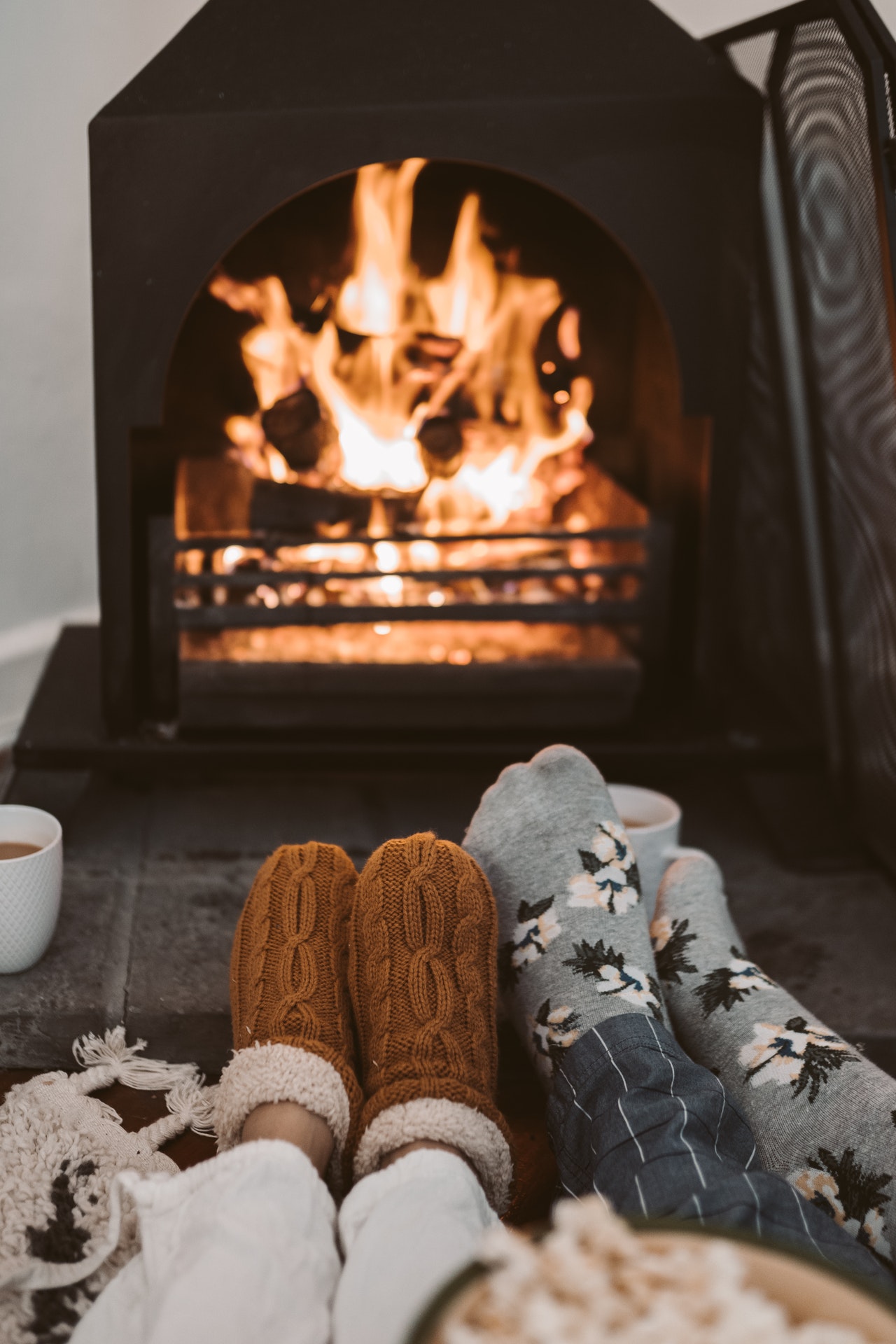
While we wait patiently for the politicians to find solutions for global warming, we should address another considerably smaller and local problem, but one no less important and which also generates many doubts and frequent family discussions: how to build a good fire to warm our homes during the winter days. Few things are as lovely as a cozy evening next to a good fire. And in the Oeste region of Portugal, many houses have a fireplace. The problem is that not everyone is familiar with the characteristics of the different types of wood or how to light the fire effectively. When doubts appear, we have fertile ground for heated arguments which defeat the nice ambience the fire will give.
So we will try to clarify some basic questions about this subject. The first commandment is that you will love the dry wood with all your heart. The key is not the type of wood or the size of the log; the key is that it is cut and dried for a year or that, at least, has spent a summer in the sun.
Second, we must place the elements to allow a good circulation of air since oxygen is essential to good combustion. So, if we are dealing with a heating unit with a door, it is critical that in the ignition phase, we open to the maximum the air inlet that is usually found in its lower part.
One of the most popular configurations to start the fire is to make a small pyramid in which we will place in the center a firestarter pill, around it a few crumpled papers, on them several small pieces of wood, barely one or two centimeters thick and between 10 and 20 centimeters long, or several dried pinecones, and on the upper section some larger branches. Once the fire is going strong, we can then start putting in the larger logs, which will give us a couple of hours of good heat.
As for the type of firewood that we must choose, in Portugal the most common are eucalyptus, olive, holm oak and cork oak. The holm oak and cork oak are the hardest, which will take longer to start but, in exchange, offer greater heat capacity and longer burn time. Therefore, a good strategy may be to start the fire first with a smaller log of olive tree; olive wood usually has more oily resin and burns more efficiently. Then we can continue with a medium-size log of eucalyptus, and when we have already a well-consolidated fire, we can place some thick logs of holm oak or cork oak. With this formula, we will have success and family peace guaranteed.
If what we are preparing is an outdoor barbecue, olive or orange tree logs are the most advisable to make paellas or to use with casseroles, as they give a good and lively flame, while the oak embers are the ones that give the best flavor for meat and fish. The eucalyptus wood has a special aroma, quite pleasant for indoor fireplaces but less advisable for cooking since it also releases sparks frequently.
Regarding shopping, the first advice is to try to go to a specialized firewood provider. They have adequate spaces to dry and keep firewood and they can advise us accurately depending on our objectives. In all the towns and cities there is usually some provider of this type but sometimes they are small shops, without presence on the internet, and to locate them it is necessary to ask the local people.
If we try to buy on a bank holiday or at a late hour and so it is impossible to go to one of these local specialists, we can always resort to the supermarket options. But given that there we will have much less certainty about how young or dry the logs are, it is better to go for the briquette type options that are now widely available.
The briquettes are compacted cylinders of sawdust and wood, of similar size or something smaller than the traditional burning logs. Their biggest advantage is that they are very dry and burn well. In return, they are more expensive and do not last as long as normal logs.
And the last option, if we have no other choice, would be the logs sold at supermarkets and gas stations, which usually come in bundles or bags. They are the ones that will normally have less time cut and a higher degree of humidity. Arriving at a house that has been closed for some time, with a cold flue, and to try to start a fire with this type of logs can generate great frustration, to the point of believing that what we have been sold are logs with a layer of flame-retardant coating. In those cases you have to be very patient and try to put special effort in the first phase; using more papers, more dried pinecones and smaller branches, which help build a good amount of heat before placing these “fireproof” logs. And if you still do not get the intended result, we can always resort to the alcohol trick, which basically consists of having a few shots that will warm us inside, will make us happy on the outside and, most likely, will allow us to forget about wanting a fire in the first place.